Dreaming of studying medicine amidst Renaissance art, vibrant piazzas, and world-class healthcare? Italy offers an enticing path for international students, blending high-quality education with a unique cultural experience. For Non-EU students, understanding the system – the critical IMAT exam, public vs. private universities, and the application maze – is key. This DoctorTravelLog guide cuts through the complexity.

Why Study Medicine in Italy?
- Internationally Recognized Degrees: Graduates earn an MD degree (equivalent to MBBS/MBChB) recognized throughout the EU and widely respected globally. Graduates can pursue licensure worldwide (subject to specific country exams like USMLE, PLAB, NEXT).
- High Academic Standards: Italian medical schools boast rigorous curricula, strong theoretical foundations, and increasingly integrated clinical exposure, often within Italy’s respected public healthcare system (SSN).
- Significant Cost Advantage (Especially Public): Compared to the US, UK, Canada, or Australia, Italy offers remarkable value, particularly at public universities.
- Unique Cultural & Lifestyle Experience: Immerse yourself in history, art, food, and the Italian way of life while pursuing your medical career.
- English-Taught Programs: Most international spots are in English-taught programs, eliminating a major language barrier for entry and study.
- Gateway to the EU: An Italian degree facilitates further training or practice within the European Union.
The Core Distinction: Public vs. Private Universities

| Feature | Public Universities | Private Universities |
|---|---|---|
| Tuition Fees | Based on Family Income (ISEE Equivalent): Ranges from ~€150 to ~€4,000+ per year. Requires detailed financial documentation. | Fixed Annual Fees: Significantly higher. Typically €15,000 – €25,000+ per year. |
| Funding Source | Primarily government-funded. | Self-funded through tuition and private sources. |
| Number of Seats (Int’l) | Limited: Dedicated quota for Non-EU students (varies yearly/university). Highly competitive. | Often More Seats: Dedicated Non-EU quota, sometimes larger than public, but still competitive. |
| IMAT Requirement | Mandatory: Admission solely based on IMAT rank within the Non-EU quota. | Usually Mandatory: Most require IMAT, but may have additional entrance pathways/interviews (CHECK per university!). |
| Teaching Quality | Generally very high, steeped in tradition. | Generally high, often with modern facilities & approaches. May have stronger industry links. |
| Clinical Exposure | Extensive within the public SSN hospitals. | Often within affiliated hospitals (can be public or private); scope varies. |
| Atmosphere | Larger, more traditional, diverse student body. | Often smaller cohorts, potentially more personalized attention. |
Key Universities Offering Medicine in English (Non-EU Quota – Examples 2024/25 Cycle):
- Public Universities:
- University of Milan (Milano)
- University of Padua (Padova)
- University of Pavia (Pavia)
- Sapienza University of Rome (Roma)
- University of Turin (Torino)
- University of Bologna (Bologna)
- University of Bari (Bari)
- University of Naples Federico II (Napoli)
- University of Messina (Messina)
- University of Siena (Siena)
- Private Universities (Require IMAT unless specified otherwise*):
- Humanitas University (Milan) – Highly regarded, modern
- Università Campus Bio-Medico di Roma (Rome)
- Università Vita-Salute San Raffaele (Milan)
- Università Cattolica del Sacro Cuore (Rome) – May have alternative pathways, check!
- UniCamillus International Medical University (Rome)
- University of Modena and Reggio Emilia (Modena/Reggio Emilia) – Public but fee structure similar to private for int’l? Check specifics.
Crucial Note: The exact number of seats for Non-EU students is set annually by each university and the Italian Ministry of Education (MUR). This number fluctuates yearly! Always check the official university website and the MUR/Ministry decrees (usually published Spring/Summer) for the current year’s seat allocation. Competition is fierce for both public and private seats.
The Heart of the Application: The IMAT Exam
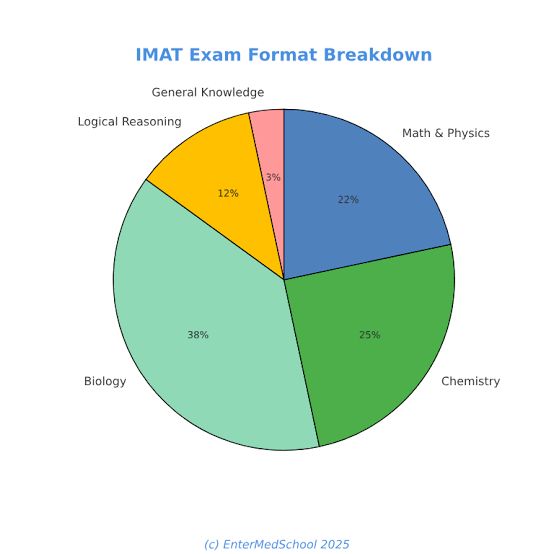
The International Medical Admissions Test (IMAT) is the central gateway for most medicine programs in Italy taught in English, especially for Non-EU applicants.
- What it is: A 100-minute, 60-question multiple-choice exam testing:
- Logical Reasoning & General Knowledge (12 Qs)
- Biology (18 Qs)
- Chemistry (12 Qs)
- Physics & Maths (8 Qs)
- Scoring: +1.5 for correct, -0.4 for incorrect, 0 for blank. Max score 90.
- Language: English.
- When: Once a year, typically mid-September. (2024 date: Sept 12th).
- Where: Test centers worldwide (managed by Cambridge Assessment Admissions Testing).
- Why it’s Critical for Non-EU: Your IMAT score determines your rank within the dedicated Non-EU quota at your chosen universities. Higher rank = better chance of admission. Public universities rely solely on this rank. Private universities heavily weigh it.
IMAT Guide for Non-EU Students:
- Register Early (Crucial!):
- Registration opens ~May/June via the Universitaly portal. Do NOT delay.
- You’ll select up to two Italian medical universities (in order of preference) where you want your score considered.
- Intensive Preparation is Non-Negotiable:
- Start Early (6-12 months prior): Biology and Chemistry depth is key. Logical reasoning needs practice.
- Use Official Resources: Past papers (available on Cambridge website) are GOLD. Understand the format and question styles.
- Consider Prep Courses/Books: Dedicated IMAT prep resources (online/books) are highly recommended due to the specific nature of the exam. DoctorTravelLog can recommend trusted prep providers (Affiliate Link).
- Focus on Weaknesses: Don’t neglect Physics/Maths or Logical Reasoning.
- Timed Practice: Master the intense time pressure.
- Understand the Non-EU Competition: You are only competing against other Non-EU applicants for the designated seats. Aim for a score significantly above the historical cutoff for your chosen universities (cutoffs vary yearly and per uni).
- Results & Ranking: Results are released a few weeks after the exam. You will be ranked within the Non-EU quota for each university you applied to via Universitaly.
The Application Procedure for Non-EU Students: A Step-by-Step Timeline
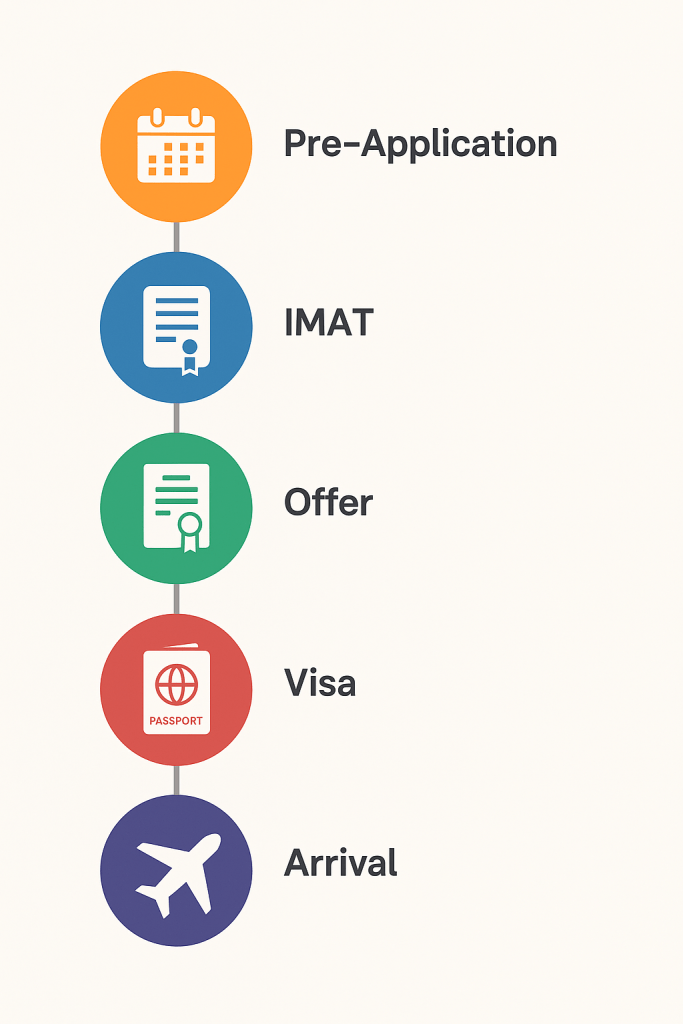
- Pre-Application (Early – Spring/Summer BEFORE IMAT):
- Research Universities: Identify 1-2 target public/private universities. Check their specific requirements, fees (public: ISEE process), and historical Non-EU IMAT cutoffs.
- Gather Documents: Start preparing your High School Diploma (or equivalent), Transcripts, Passport, Proof of English (if required, often waived if English is MOI).
- Begin IMAT Prep: Enroll in courses, get books, start practicing past papers.
- Financial Planning: Calculate costs (tuition + living ~€10,000-12,000/year). For public unis, understand the ISEE process for income-based fees (requires financial docs translated/legalized).
- Application Phase (Spring/Summer – Sept):
- Pre-enrollment on Universitaly (Critical Step!): Opens ~Spring (e.g., March/April). You MUST pre-enroll for your chosen universities and declare your intent to sit the IMAT. This is mandatory for visa purposes and exam registration. Upload required docs.
- Register for IMAT (May/June): Via Universitaly portal during the registration window. Pay the exam fee.
- Apply for “Dichiarazione di Valore” (DoV): Contact the Italian Embassy/Consulate in your home country early. The DoV certifies the validity of your high school diploma for Italian universities. This process takes MONTHS. Start ASAP after pre-enrollment. Requirements vary (translation, legalization, Apostille).
- Take the IMAT (Mid-Sept): Give it your all!
- Post-IMAT & Admission (Oct – Dec):
- IMAT Results: Released ~October.
- University Ranking Lists: Universities publish Non-EU ranking lists based on IMAT scores. Check the lists for your chosen unis meticulously.
- Receive Offer (if ranked high enough): If your rank is within the available seats for a university, you’ll be contacted (usually via PEC email or portal) with an offer. You MUST formally accept within a strict deadline (often just days!).
- Finalize Enrollment: Accept the offer, pay the first tuition installment (public: often after fee calculation based on DoV/ISEE docs; private: fixed fee). Submit final documents (DoV, Passport, Acceptance, Payment proof) to the university via Universitaly.
- Apply for Student Visa (Type D): Take your university acceptance letter, proof of finances (~€6,000/year minimum), accommodation proof, health insurance, flight itinerary, and DoV to your Italian Embassy/Consulate. Apply immediately after enrollment confirmation.
- Pre-Departure & Arrival (Dec/Jan):
- Secure Accommodation: University halls or private rentals. Start early!
- Health Insurance: Mandatory. Enroll in the Italian National Health Service (SSN) upon arrival (~€150/year) or have equivalent private coverage.
- Arrive in Italy: Complete university registration, get residency permit (Permesso di Soggiorno), open bank account, enroll in SSN.
Life as a Med Student in Italy:
- Language: While studies are in English, learning Italian is ESSENTIAL for effective clinical rotations (starting ~3rd year) and daily life. Universities often offer courses.
- Cost of Living: Varies (North > South). Budget carefully. Part-time work is allowed on a student visa (max 20 hrs/week).
- Culture: Embrace the Italian pace, food, and social life. Be prepared for bureaucratic processes.

Is Italy Right for You?
Pros: Affordable quality (public), EU degree, unique experience, IMAT centralizes entry.
Cons: High Non-EU competition, intense IMAT prep, complex pre-enrollment/DoV, Italian language necessity for clinics, bureaucratic challenges.
Studying medicine in Italy is an adventure demanding preparation and perseverance, especially for Non-EU students. Master the IMAT, navigate the procedures diligently, embrace the language, and you could find yourself launching a brilliant medical career under the Italian sun. Buona fortuna!
🩺 Dr.Mohammad Rizwan Feroz
👍 Found this helpful? Show some love & follow us on Instagram @doctortravellog for expert tips & fresh updates!
💬 Got thoughts or questions? React below or drop a quick comment — no login needed!
❤️ 😮 🤔 👍 👎
 Doctor Travel Log