Study Medicine in China 🇨🇳

Your Complete Guide for International Students (2025)

Unlock World-Class Medical Education at Affordable Costs
China has become a top destination for international medical students, blending ancient healing traditions with cutting-edge healthcare innovation. With over 10,000 international students enrolled in MBBS programs, China offers globally recognized degrees, state-of-the-art facilities, and rich cultural immersion—all at a fraction of Western costs. This DoctorTravelLog guide covers everything you need to embark on your medical journey in China.

International medical student in China with Chinese flag backdrop

Why China? Key Advantages

  1. MOE-Approved Degrees
    • Degrees from China’s Ministry of Education (MOE)-listed universities are recognized by WHO, ECFMG (USA), MCI/NMC (India), GMC (UK), PMC (Pakistan), BMC (Bangladesh) and more.
  2. Affordability
    • Tuition: $3,500–$10,000/year (vs. $50,000+ in the US/UK).
    • Living costs: $3,000–$5,000/year.
  3. English-Medium Programs
    • 6-year MBBS courses fully taught in English.
  4. World-Class Infrastructure
    • AI-equipped labs, simulation hospitals, and partnerships with 1,000+ teaching hospitals.
  5. Scholarship Opportunities
    • 20,000+ scholarships annually via CSC, provincial, and university programs.

State-of-the-art Chinese medical university campus

Top 20 MOE-Approved Medical Universities (2024)

Ranked by QS World University Rankings (Medicine) & Global Reputation

University City Global Ranking Annual Tuition (USD)
Peking University Health Science Center Beijing #24 (QS) $9,500
Fudan University Shanghai #29 $9,000
Shanghai Jiao Tong University Shanghai #46 $8,800
Zhejiang University Hangzhou #55 $8,500
Sun Yat-sen University Guangzhou #138 $7,200
Sichuan University Chengdu #203 $6,800

Note: Always verify MOE recognition status via China’s MOE Portal.

Peking University Health Science Center - Beijing

Admission Process: Step-by-Step (2024)

  1. Eligibility
    • Academic: 75%+ in PCB (Physics, Chemistry, Biology) at 10+2 level.
    • Age: 17–25 years.
    • Language: IELTS 6.0/TOEFL 80 (waived if prior education was in English).
    • Indian Students: Valid NEET score (50th percentile+).
  2. Application Timeline
    • Dec–Mar: Apply via university portals or authorized agents.
    • Apr–Jun: Receive offer letters & JW202 visa forms.
    • Jul–Aug: Pay fees, apply for X1 visa.
  3. Documents Checklist

    – High school transcripts + diploma

    – NEET scorecard (for Indians)

    – Passport copy

    – Medical fitness certificate

    – 2 recommendation letters

    – Personal statement

    – Non criminal certificate

International students applying for MBBS in China

Fee Structure & Scholarships

Annual Costs (USD)

  • Tuition: $3,500–$10,000
  • Hostel: $800–$2,000
  • Living Expenses: $2,000–$4,000
  • Insurance: $100–$200

Scholarships

  1. CSC Scholarship (Full Ride): Covers tuition + living stipend ($1,000/month).
  2. Provincial Scholarships: 30–50% fee waivers (e.g., Jiangsu, Beijing).
  3. University Scholarships: Merit-based (e.g., Fudan “Belt & Road” Scholarship).

Apply via CSC Portal by January 31 annually.


Reliable Consultant Agencies

Officially endorsed by Chinese MOE:

  1. CUCAS (www.cucas.cn)
  2. China Admissions (www.china-admissions.com)
  3. SICAS (www.sicas.cn)

Warning: Avoid agents demanding “admission fees”—tuition is paid directly to universities.


Pros vs. Cons: Reality Check

Pros Cons
Low cost, high ROI Mandatory Mandarin for clinicals
WHO-recognized degrees FMGE/NMC pass rates vary (30–50%)
Modern tech & research exposure Cultural adaptation challenges
Scholarship accessibility Limited or No part-time work options
Global career pathways Distance from home

Critical Tips for Success

  1. Verify Recognition: Confirm your university is listed in the World Directory of Medical Schools.
  2. Learn Mandarin: HSK 4 proficiency required for hospital rotations (Year 4+).
  3. Plan Licensing Early: Prep for home-country exams (USMLE, PLAB, FMGE) during your MBBS.
  4. Cultural Prep: Adapt to collaborative (vs. competitive) learning styles.

The DoctorTravelLog Verdict

“China offers unparalleled value for aspiring doctors, but success demands diligence. Choose MOE-approved universities, master medical Mandarin before internship, and align your studies with home-country licensing requirements. For the disciplined student, it’s a launchpad to a global career.”


Next Steps

  1. Explore verified student reviews on MDinChina Forum.
  2. Questions? Ask in the comments below!

Disclaimer: Policies change yearly. Always cross-check with university admissions offices.

Dr.Mohammad Rizwan Feroz

👍 Found this helpful? Show some love & follow us on Instagram @doctortravellog for expert tips & fresh updates!

💬 Got thoughts or questions? React below or drop a quick comment — no login needed!

❤️ 😮 🤔 👍 👎

Study Medicine in Germany 🇩🇪: Pros, Cons, Eligibility & How to Apply (2024 Guide)

🩺 Study Medicine in Germany: Your Complete Guide for International Students

Germany’s world-renowned medical schools, cutting-edge research, and tuition-free public universities make it a top destination for aspiring doctors. But fierce competition, strict eligibility, and complex applications demand careful planning. This guide breaks down everything you need – from pros/cons to visas – for your German medical journey.

✅ Why Study Medicine in Germany? Key Benefits

  • World-Class Education

    Globally recognized degrees, research-focused curriculum, and hands-on training at university hospitals.
  • Low or No Tuition Fees

    Public universities charge only €150–400/semester (admin fees). Exception: Baden-Württemberg charges non-EU students €1,500/semester.
  • Strong Career Pathways

    Germany’s doctor shortage simplifies post-graduate work visas. Degrees are EU-recognized.
  • Living in Europe

    High quality of life, efficient public transport, and rich cultural experiences.

⚠️ Challenges to Consider

  • Extreme Competition

    Only 5–8% of medical seats are allocated to non-EU international students.
  • Perfect Grades Required

    You’ll need near-perfect scores (German GPA 1.0–1.2 ≈ 95%+).
  • German Language Mastery

    C1-level certification (TestDaF/DSH) is mandatory before applying. No English programs!
  • High Living Costs

    Proof of €11,208/year in a blocked bank account is required.

📋 Eligibility: Do You Qualify?

Requirement Details
Academic Records Secondary school diploma equivalent to German Abitur (check Anabin). Low grades? Prepare for Studienkolleg.
Science Subjects Top marks in Biology, Chemistry, Physics & Math.
Language Proof C1 German certificate (TestDaF 4×4, DSH-2, Goethe C2, or Telc C1).
Internship 4–8 weeks of healthcare work (Vorpraktikum) may be required.
Entrance Exams TMS/MedAT test scores boost admission chances.

📅 Application Timeline & Process

(Start 18 months before your intake!)

  1. Research Universities

    Target public universities with non-EU quotas (e.g., Charité Berlin, Heidelberg, LMU Munich).
  2. Get Academic Validation

    → Submit transcripts to uni-assist for a VPD (Pre-Document Review). Takes 6–8 weeks!
  3. Prepare Documents
    • VPD report
    • C1 German certificate
    • Motivational letter (in German)
    • CV, passport, proof of internship
    • APS certificate (if from China, India, Vietnam)
  4. Apply via uni-assist

    Submit before July 15th for winter intake. Apply to 4–6 universities to maximize chances.
  5. After Admission
    • Open a blocked account (€11,208/year)
    • Apply for a student visa
    • Secure health insurance & housing

💡 Key Tips for Success

  • Learn German early – Aim for C1 before finishing high school.
  • Boost your grades – Even 0.1 GPA points matter.
  • Gain clinical experience – Volunteering strengthens applications.
  • Apply strategically – Mix high- and mid-competition universities.

❓ FAQs: Studying Medicine in Germany

Q: Can I study medicine in Germany in English?
A: No. Only German-taught programs are accredited.

Q: Is the MCAT required?
A: No, but the German TMS or Austrian MedAT tests are recommended.

Q: How long is the medical program?
A: 6 years + 3 months (Staatsexamen exam included).

Q: Can I work as a doctor in Germany after graduation?
A: Yes! Complete the Approbation (medical license) and residency (Facharztausbildung).

🧠 The Verdict

Germany offers a world-class, affordable medical degree with strong career prospects – but only for students with flawless academics, advanced German skills, and meticulous preparation. Start early, target 4+ universities, and master the bureaucracy to succeed.

Ready to take the next step?
👉 Book a Consultation with DoctorTravelLog experts!

👍 Found this helpful? Show some love & follow us on Instagram @doctortravellog for expert tips & fresh updates!

💬 Got thoughts or questions? React below or drop a quick comment — no login needed!

❤️ 😮 🤔 👍 👎

Studying Medicine in the UK: Your Realistic Guide as a Non-EU Applicant (Beyond the Dream)

Dreaming of walking the historic halls of a UK medical school, training in the NHS, and earning a globally revered MBBS or MBChB? You’re not alone. The UK’s medical education is a beacon for international students, renowned for its rigor, clinical excellence, and the prestige of institutions like Oxford, Cambridge, Imperial, and UCL. But as a non-EU applicant, the path involves distinct challenges, costs, and processes post-Brexit.


This isn’t about selling a fantasy; it’s your practical roadmap to understanding what it *truly* takes to study medicine in the UK from outside the EU/EEA.

Why the UK? The Enduring Allure

  • Global Recognition & Standards: A UK medical degree is a passport respected by medical councils worldwide (though licensure in your home country will still require specific exams). The General Medical Council (GMC) sets exceptionally high standards.
  • Integrated Clinical Exposure: From early years, you’re immersed in the National Health Service (NHS), gaining hands-on experience in diverse clinical settings under expert supervision.
  • Research Powerhouse: Access to cutting-edge medical research and innovation is embedded in the curriculum at leading universities.
  • Quality of Teaching: Problem-based learning (PBL) and a strong emphasis on communication and ethics shape well-rounded future doctors.
  • Cultural & Linguistic Advantage: Studying in an English-speaking country eliminates a major language barrier for many, and the UK offers a vibrant, multicultural student experience.

The Reality Check: Key Challenges for Non-EU Applicants

1. Stiff Competition:

  • Limited Spaces: Medicine is the most competitive undergraduate degree in the UK. International student quotas are small.
  • Academic Excellence Required: You’ll need near-perfect grades in science subjects (Biology, Chemistry, often Physics/Maths) equivalent to top A-levels (e.g., A*AA or higher). Your high school qualifications must be rigorously assessed for equivalence (UCAS tariff points).
  • Entrance Exams: Almost all universities require either the UCAT (University Clinical Aptitude Test) or the BMAT (BioMedical Admissions Test). High scores are non-negotiable. Preparation is intense and costly.
  • Interviews: Multiple Mini Interviews (MMIs) are standard. They assess communication, empathy, ethics, resilience, and motivation – demanding thorough preparation, often remotely.

2. Significant Financial Investment:

  • Tuition Fees: This is the biggest hurdle. Non-EU international fees for medicine are substantially higher than for home/EU students. Expect £25,000 to £50,000+ PER YEAR for tuition alone (varies by university, with London/Oxbridge at the top end).
  • Living Costs: Especially in cities like London, Oxford, or Cambridge, budget at least £12,000 to £18,000+ per year for accommodation, food, transport, books, and personal expenses.
  • Immigration Health Surcharge (IHS): Mandatory for your Student Visa, granting access to the NHS. Currently £1,035 PER YEAR. Payable upfront for your entire visa duration.
  • Visa Fees: Application costs add several hundred pounds.
  • Total Cost: A 5-6 year degree can easily exceed £250,000+. Scholarships are scarce and fiercely competitive for medicine.

3. The Visa Journey:

  • Student Visa (Tier 4): You’ll need an unconditional offer and proof of sufficient funds covering the first year’s tuition + living costs (held for 28 days minimum) before applying.
  • English Language Proof: Usually IELTS Academic (typically 7.0+ overall, with minimums in each component) or equivalent.
  • TB Test: Required if coming from a listed country.
  • Biometrics & Processing: Allow ample time.

4. Post-Study Work & Foundation Training:

  • The Graduate Route: Allows you to stay and work (in any field) for 2 years (undergrad) or 3 years (PhD) after graduation. This is your bridge.
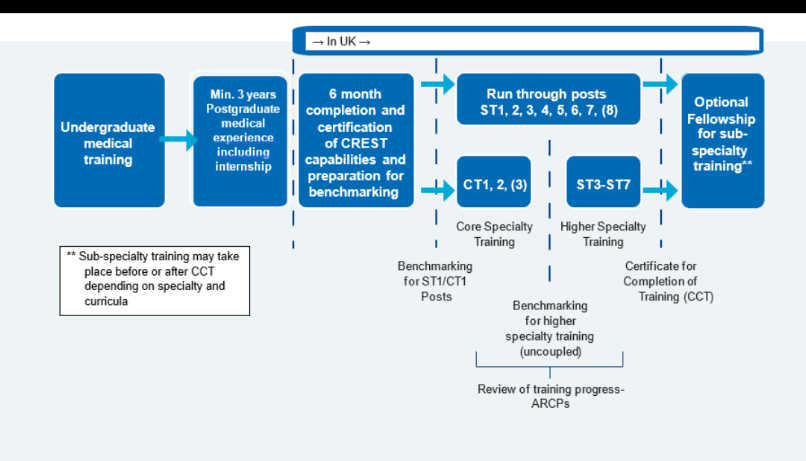
  • Foundation Programme (FY1/FY2): To practice as a doctor in the UK, you must complete this 2-year paid training programme within the NHS.
    • You compete in a separate, smaller allocation within the national application process.
    • You need full GMC registration before starting FY1, which requires passing the PLAB (Professional and Linguistic Assessments Board) exams (Part 1 often taken during studies, Part 2 after graduation). This is a major additional hurdle.
    • Visa sponsorship for the Foundation Programme is complex and not guaranteed.

The Non-EU Applicant Pathway: Step-by-Step

1. Research & Self-Assessment (Early – Years 11/12 or equivalent):

  • University Shortlisting: Focus on universities welcoming internationals, check their specific entry requirements, fees, UCAT/BMAT policy, and course
    structure. Use UCAS search tools.
  • Financial Planning: Be brutally honest about affordability. Explore all potential funding sources early (family savings, home country loans, rare scholarships).
  • Academic Focus: Excel in core science subjects.

2. Prepare for & Take Entrance Exams (Year 12/AS Level equivalent):

  • UCAT (July-Sept intake year): Widely used, computer-based. Requires dedicated prep (mocks, courses).
  • BMAT (Nov intake year): Used by Oxbridge, Imperial, UCL, Leeds, Brighton & Sussex. Tests science, maths, critical thinking, writing.

3. Craft Your UCAS Application (Sept 1st Deadline for Medicine):

  • Academic Reference: Must be stellar, from a science teacher.
  • Personal Statement: Crucial! Demonstrate motivation, relevant experience (shadowing, volunteering), skills, understanding of medicine/UK NHS. Avoid clichés.
  • Choices: Maximum 4 medical school choices. Choose strategically based on predicted grades, exam scores, and competition.

4. Interview Preparation (Nov-Feb):

  • MMI Practice: Essential. Focus on ethics, NHS awareness, communication, handling scenarios. Practice with peers, teachers, or professional services.

5. Receive Offers & Meet Conditions (Dec-April):

  • Conditional Offers: Usually require achieving specific grades in final exams and meeting language requirements.
  • Unconditional Offer: Your golden ticket (if no conditions).

6. Secure Funding & Apply for Visa (After Unconditional Offer):

  • Proof of Funds: Get documentation ready (bank statements meeting UKVI requirements).
  • Apply for CAS: Your university issues a Confirmation of Acceptance for Studies.
  • Apply for Student Visa: Submit CAS, financial proof, passport, TB test (if needed), pay IHS and visa fee. Attend biometrics appointment.

7. Prepare for Relocation & Studies:

  • Accommodation, flights, orientation, NHS registration.

Life as a Non-EU Medical Student in the UK:

  • Community: Connect with international student societies and medical student associations. Build a support network.
  • Work: Student visa allows limited part-time work (usually 20 hrs/week during term, full-time in holidays). Balance is key – medicine is demanding.
  • Culture: Embrace the experience! Explore the UK, engage with different cultures on campus and in the NHS.
  • Plan Ahead: Start thinking about PLAB and Foundation Programme applications during your studies. The Graduate Route gives you time, but preparation is lengthy.

Is It Worth It? A Candid Perspective

Studying medicine in the UK as a non-EU student is an incredible opportunity, but it’s a massive investment of intellect, effort, and finances. It’s worth it if:

  • You are academically exceptional and resilient.
  • Your family can comfortably afford the entire cost without crippling debt.
  • You are genuinely passionate about the UK system and potentially working there long-term (understanding the hurdles to Foundation training).
  • You see the value beyond just the degree – the clinical training, research exposure, and international experience.

It might not be the best path if:

  • Cost is a primary barrier with no secure funding.
  • Your primary goal is to practice immediately in your home country (a local or cheaper international degree might be more efficient).
  • You underestimate the intense competition and workload.

Your Next Steps with DoctorTravelLog:

Resources for Studying Medicine in the UK (for International Students)

  1. Use Our University Finder: Filter UK medical schools by international fees, UCAT/BMAT requirements, and location. Find the perfect fit for your goals and budget.
  2. Download Our Budget Planner: Calculate your realistic total costs (tuition + living expenses) for different universities before applying.
  3. Explore UCAT/BMAT Prep Resources: Access trusted prep courses and practice materials to improve your scores. (Includes affiliate links to recommended providers.)
  4. Book a UK Medicine Consultancy Session: Get personalized advice on your academic profile, application strategy, and university shortlist from experienced consultants.
  5. Join the Forum: Connect with other international applicants and current students. Share your journey, ask questions, and get real insights.

The UK medical dream is demanding, but for the well-prepared, determined, and supported non-EU applicant, it remains a profoundly rewarding journey. Arm yourself with knowledge, plan meticulously, and step forward with your eyes wide open. Your stethoscope awaits – are you ready for the challenge?

Got questions? Share them below or explore DoctorTravelLog’s dedicated UK Medicine section for deeper dives!

— Dr. Mohammad Rizwan Feroz

👍 Found this helpful? Show some love & follow us on Instagram @doctortravellog for expert tips & fresh updates!

💬 Got thoughts or questions? React below or drop a quick comment — no login needed!

❤️ 😮 🤔 👍 👎