On this Doctor’s Day, we honor the dedication, compassion, and tireless service of doctors everywhere. Your commitment saves lives, brings hope, and strengthens our communities. Thank you for your selfless care and for being the healing hands we all rely on.
Your Guide to Choosing the Right Path in Eastern Europe
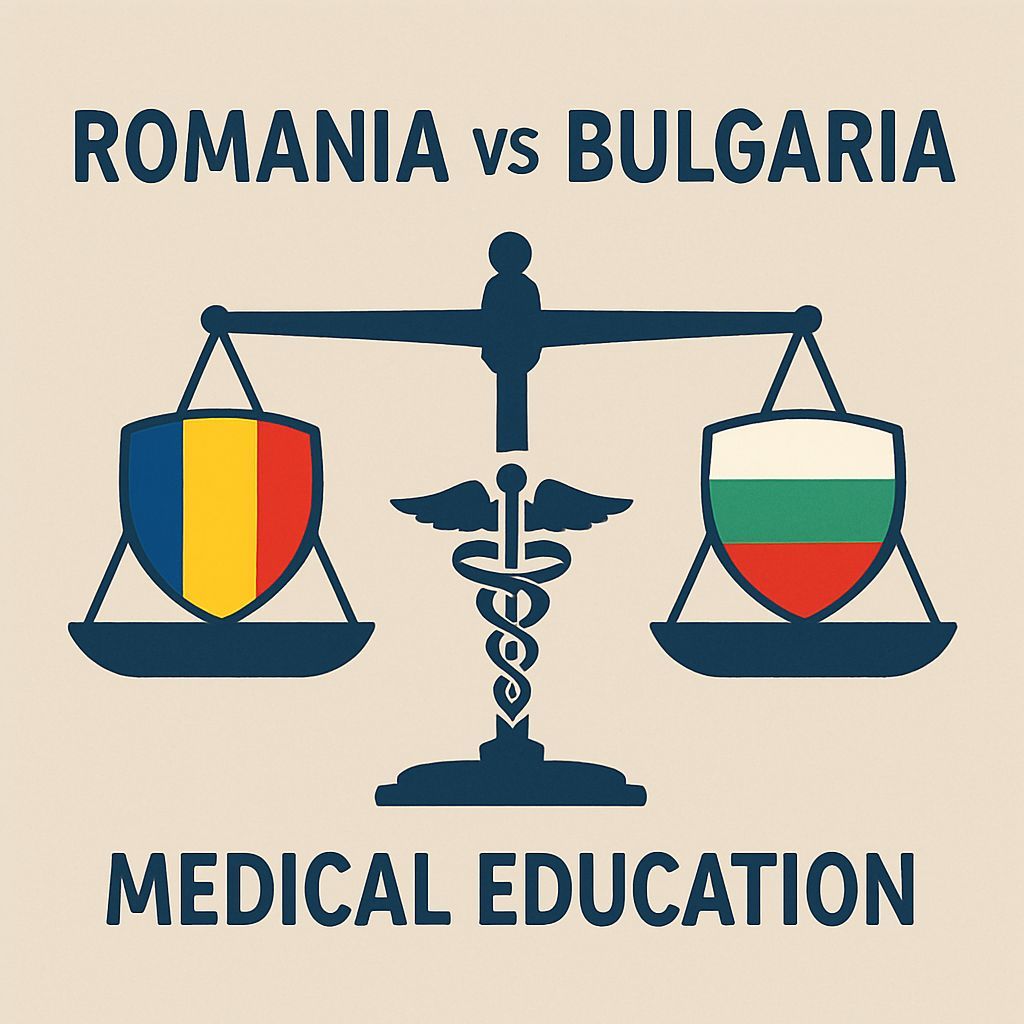
Dreaming of a prestigious medical career? Eastern Europe, with its blend of high-quality education, affordability, and rich cultural experiences, is a magnet for international medical students. Romania and Bulgaria stand out as top contenders. But which one is the perfect fit for you? Let’s break down the key factors to help you decide where to pursue your MBBS or MD.
Why Consider Romania or Bulgaria?
Both countries offer compelling advantages:
Internationally Recognized Degrees: Graduates are eligible for licensing exams worldwide (USMLE, PLAB, etc.), provided they meet specific country requirements.
EU Standard Education: Adherence to the Bologna Process and high academic standards.
Significantly Lower Costs: Tuition fees and living expenses are far more affordable than in Western Europe, North America, or Australia.
English-Taught Programs: Extensive options available, removing major language barriers.
Cultural Richness & Travel: Vibrant histories, stunning landscapes, and gateway locations to explore Europe.
Head-to-Head Comparison: Romania vs. Bulgaria for Medical Studies
1. Degree Recognition & Practice Opportunities:
Romania: Medical degrees are recognized throughout the European Union (EU). This grants automatic qualification to practice in any EU/EEA country after completing necessary internships/licensing procedures there. Recognition in non-EU countries (USA, Canada, Middle East, India) is generally strong, but always verify with your home country’s medical council.
Bulgaria: Similarly, Bulgarian medical degrees are EU-recognized, offering the same pathway to practice within the EU/EEA. Recognition outside the EU is also generally good, but requires verification with your target country’s authorities.
Key Point:Both are excellent for EU practice. For global practice, both are solid, but always confirm specific requirements with your home/target country’s medical council. No significant advantage here.
2. Language of Instruction:
Romania: Offers a wider selection of fully English-taught medical programs across more universities (e.g., Carol Davila Bucharest, Iuliu Hațieganu Cluj-Napoca, Victor Babeș Timișoara, Grigore T. Popa Iași). Romanian language courses are often integrated to aid patient interaction during clinical years.
Bulgaria: Also offers well-established English-taught programs, primarily in major universities like Medical University Sofia, Plovdiv Medical University, and Varna Medical University. Learning basic Bulgarian is encouraged for clinical practice.
Key Point:Both offer English programs. Romania often has a slightly broader choice of universities and cities with English tracks.
3. Tuition Fees & Cost of Living:
Tuition Fees (Approx. per year):
Romania: €5,000 – €8,000 (can be higher in top unis like Carol Davila).
Key Point:Bulgaria often has a slight edge in affordability, particularly regarding living costs. Both are significantly cheaper than the West.
4. Academic Quality & Structure:
Both: Provide robust theoretical foundations and increasing clinical exposure. Programs are typically 6 years (including a final year of internship/practice). Teaching methods blend lectures, seminars, labs, and hospital rotations.
Focus: Quality is generally comparable. Research opportunities exist in both. Some Romanian universities (like Carol Davila) have particularly strong historical reputations and links to large university hospitals. Bulgarian universities like Sofia are also highly regarded.
Key Point:Quality is largely comparable. Research specific university rankings, faculty, hospital affiliations, and student reviews for your shortlist.
5. Admission Process & Requirements:
Both: Generally require:
High School Diploma (Biology, Chemistry, Physics crucial).
Good grades (especially in science subjects).
Entrance Exam (Biology, Chemistry) or consideration of High School grades. Entrance exams are common for both.
English Proficiency (TOEFL/IELTS or university test if English isn’t your first language).
Medical Certificate.
Application documents (passport, photos, etc.).
Key Point:Processes are very similar. Focus on preparing strong science grades and for potential entrance exams.
6. Student Life, Culture & Environment:
Romania:
Culture: Latin roots (Romanian is a Romance language), diverse influences. Vibrant cities like Bucharest (cosmopolitan), Cluj-Napoca (youthful tech hub), Iași (academic tradition), Timișoara (Western feel).
Geography: Carpathian Mountains, Black Sea coast, Transylvania region.
Atmosphere: Generally perceived as slightly more “Westernized” in major cities.
Bulgaria:
Culture: Slavic roots, rich Thracian and Ottoman heritage. Sofia (bustling capital), Plovdiv (ancient European Capital of Culture), Varna (seaside resort feel).
Geography: Balkan Mountains, Black Sea coast, ski resorts.
Atmosphere: Often seen as slightly more laid-back, with very warm hospitality.
Key Point:Subjective! Romania offers Latin energy and diverse city vibes. Bulgaria provides a distinct Slavic/Balkan charm and beautiful coastline. Both are safe and welcoming. Consider visiting or researching cities extensively.
The Verdict: Which Should You Choose?
There’s no single “best” country. The right choice hinges on your priorities:
Choose Romania if:
You prioritize having the widest choice of English-taught programs across different cities.
You are drawn to a culture with Latin influences and diverse city atmospheres (from bustling Bucharest to historic Cluj).
Slightly higher tuition in some top unis is acceptable within your budget.
Choose Bulgaria if:
Overall affordability (especially living costs) is your absolute top priority.
You prefer a distinctly Slavic cultural experience and love the idea of easy access to the Black Sea coast.
You find the atmosphere of cities like Plovdiv or Varna particularly appealing.
Crucial Steps Before Deciding:
Verify Recognition:Absolutely essential! Contact the medical council in the country where you ultimately wish to practice (e.g., MCI/NMC for India, ECFMG for USA, GMC for UK) to confirm their specific requirements for graduates from your shortlisted universities in Romania or Bulgaria.
Research Universities: Go beyond the country level. Investigate specific medical universities:
Curriculum details and clinical exposure opportunities.
Entrance exam format and dates.
Student support services for international students.
Campus facilities and affiliated hospitals.
Student reviews and alumni networks.
Consider the City: Where will you live for 6 years? Research safety, cost of living, accommodation options, transportation, and overall vibe of the cities housing your chosen universities.
Budget Realistically: Factor in tuition, accommodation, food, transport, health insurance, books, and personal expenses for the entire duration. Include potential travel costs.
Final Thoughts
Both Romania and Bulgaria offer exceptional pathways to a global medical career at a fraction of the cost found elsewhere. You’ll receive an EU-recognized degree, quality education, and an unforgettable cultural experience.
By carefully weighing the factors of language preference, specific university strengths, budget nuances, cultural fit, and most importantly, recognition for your target practice country, you can confidently choose whether the vibrant, Latin-flavored avenues of Romania or the warm, affordable, and coastal charm of Bulgaria is the ideal launchpad for your medical dreams.
Ready to explore specific universities? Visit DoctorTravelLog for in-depth profiles of leading medical schools in Romania and Bulgaria, application guides, and student experiences! Start your journey today.
Disclaimer: Fees, admission requirements, and recognition policies can change. Always verify the latest information directly with the universities and relevant medical councils before applying.
👍 Found this helpful? Show some love & follow us on Instagram @doctortravellog for expert tips & fresh updates!
💬 Got thoughts or questions? React below or drop a quick comment — no login needed!
An ER Doctor in Muscat Explains the Critical Difference
As an emergency physician working in Muscat, I see firsthand the confusion surrounding the terms “heart attack” and “cardiac arrest.” Often used interchangeably, they describe two distinct, though sometimes related, life-threatening events. Understanding this difference isn’t just medical jargon – it can be the difference between life and death. Knowing what to look for and how to react is crucial.
The Core Difference: Plumbing vs. Electricity
Think of your heart as a house:
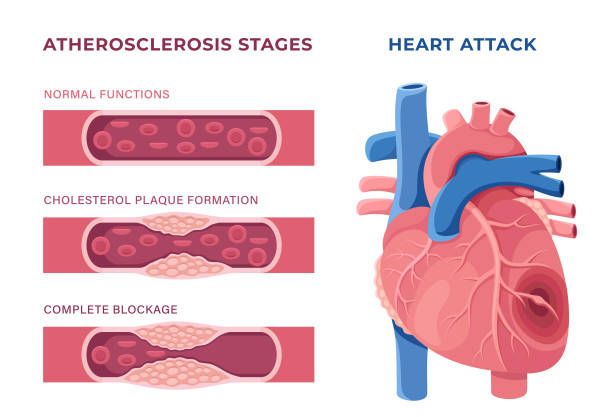
1. Heart Attack (Myocardial Infarction): A Plumbing Problem
What Happens: A blocked pipe! One or more coronary arteries supplying blood to the heart muscle itself become obstructed, usually by a blood clot forming on top of a cholesterol plaque. This blockage cuts off oxygen-rich blood to a section of the heart muscle.
Analogy: A clogged pipe preventing water from reaching a specific room. That room (heart muscle) starts to suffer damage.
The Heart: Usually still beating. The problem is blood flow to the heart muscle.
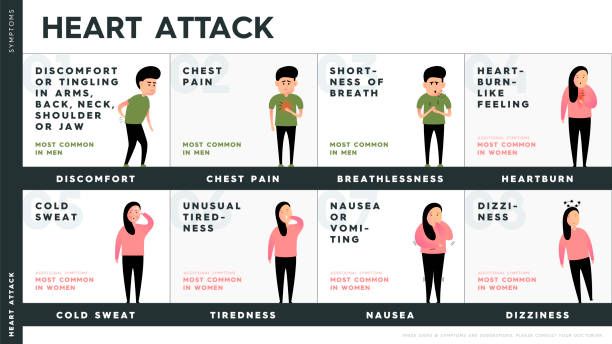
Symptoms (Often Gradual, Can Last Hours/Days):
Chest pain, pressure, tightness, or squeezing (like an elephant sitting on your chest)
Pain radiating to arm(s), neck, jaw, shoulder, or back
Shortness of breath
Cold sweat
Nausea/vomiting
Lightheadedness
Unusual fatigue
(Important Note: Symptoms can be subtle, especially in women and diabetics – don’t ignore unusual feelings!)
Outcome Without Treatment: The affected heart muscle begins to die. This damage can weaken the heart, lead to heart failure, or trigger a cardiac arrest.
2. Cardiac Arrest: An Electrical Problem
What Happens: A sudden power outage! The heart’s electrical system malfunctions, causing the heart to beat chaotically (ventricular fibrillation) or stop beating altogether (asystole). This halts effective pumping. Blood stops flowing to the brain, lungs, and other vital organs.
Analogy: The house’s electrical system shorts out, plunging everything into darkness and stopping all function instantly.
The Heart: Stops beating effectively or stops completely. No pulse. No blood flow.
Symptoms (Sudden and Dramatic):
Sudden collapse
Loss of consciousness/unresponsiveness
No normal breathing (may have gasping agonal breaths)
No pulse
Outcome Without Immediate Treatment: Death within minutes. Brain damage starts after just 4-6 minutes without blood flow.
The Critical Link: How One Can Lead to the Other
A severe heart attack can cause an electrical disturbance that triggers cardiac arrest.
Other conditions like severe arrhythmias, electrocution, drowning, trauma, or respiratory failure can also cause cardiac arrest without a preceding heart attack.
Why This Difference Matters in Muscat (and Everywhere Else)
1. Recognition:
Knowing the symptoms helps you identify the problem faster. Chest pain demands urgent medical attention before it might turn into arrest. Unresponsiveness and no breathing is cardiac arrest now.
2. Response:
Heart Attack:Call Emergency Services Immediately (999 in Oman). Every minute of delay means more heart muscle damage. Chew aspirin (if not allergic) as advised while waiting for help. Do NOT drive yourself.
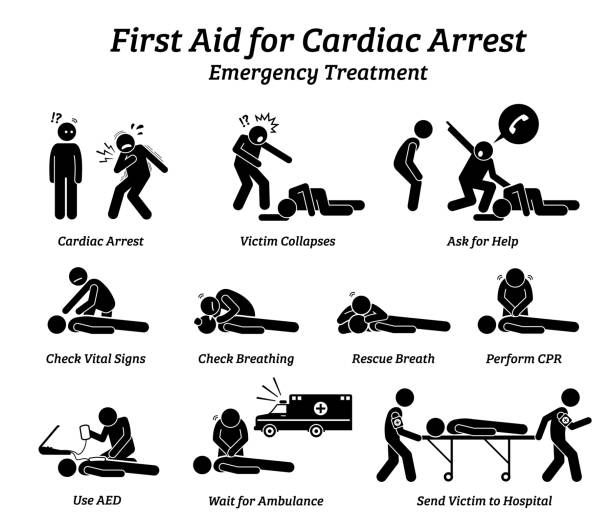
Cardiac Arrest:This is an absolute emergency requiring instant action:
Shout for Help & Dial 999.
Start CPR (Cardiopulmonary Resuscitation) IMMEDIATELY: Push hard and fast (at least 5-6 cm deep, 100-120 beats per minute) in the center of the chest. Don’t stop until help arrives or an AED is ready.
Use an AED (Automated External Defibrillator) if available: Turn it on and follow the voice prompts. These devices can shock the heart back into a normal rhythm and are increasingly available in public places in Muscat. CPR + AED use within the first few minutes is the ONLY chance for survival.
Prevention: Your Best Defense
While not always preventable, managing risk factors significantly lowers your chances:
Control Blood Pressure & Cholesterol
Manage Diabetes
Quit Smoking/Vaping
Maintain a Healthy Weight
Exercise Regularly
Eat a Heart-Healthy Diet (Mediterranean style is excellent)
Manage Stress
Attend Regular Health Check-ups
The Bottom Line from the Muscat ER:
A heart attack is a circulation problem – blood flow to the heart is blocked. The person is usually conscious and experiencing symptoms. Call 999 immediately.
Cardiac arrest is an electrical problem – the heart stops beating effectively. The person is unconscious, not breathing normally, and has no pulse. This requires immediate CPR and an AED. Call 999 and START COMPRESSIONS NOW.
Understanding this difference empowers you to act swiftly and correctly. Share this knowledge. Encourage CPR training – it’s a lifesaving skill anyone can learn. Your actions in those critical first minutes before help arrives here in Muscat can make all the difference.
👍 Found this helpful? Show some love & follow us on Instagram @doctortravellog for expert tips & fresh updates!
💬 Got thoughts or questions? React below or drop a quick comment — no login needed!
Travel unlocks incredible experiences, but the dreaded jet lag can turn arrival into a fog of fatigue, insomnia, and irritability. As a travel medicine specialist, I see countless patients battling this circadian rhythm disruption. The good news? Jet lag isn’t inevitable. With proactive, science-backed strategies, you can significantly minimize its impact and hit the ground running. Here’s your expert guide to effective jet lag remedies.
Understanding the Enemy: Why Jet Lag Happens
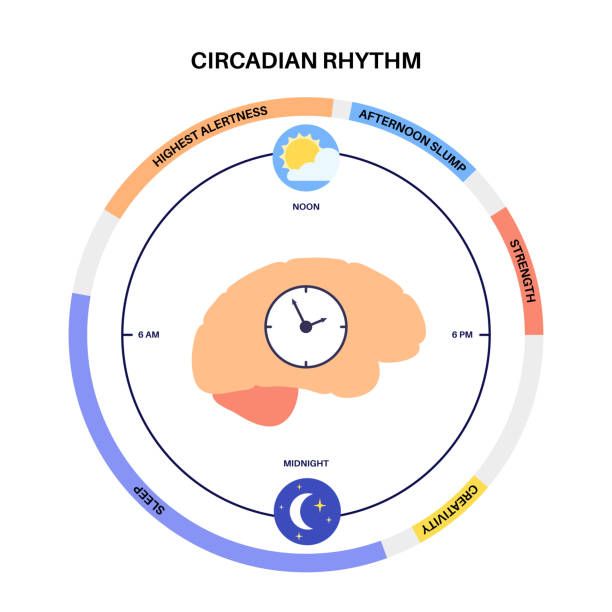
Jet lag occurs when your internal body clock (circadian rhythm), which regulates sleep-wake cycles, hormone release, digestion, and body temperature, becomes misaligned with the external light-dark cycle of your new time zone. Crossing multiple time zones, especially eastward travel, forces this internal clock to play catch-up. Symptoms include:
Insomnia or excessive daytime sleepiness
Difficulty concentrating (“brain fog”)
Fatigue and low energy
Mood swings, irritability
Digestive upset (constipation or diarrhea)
General malaise
Travel Doctor’s Toolkit: Proven Jet Lag Remedies
1. Start Adjusting BEFORE You Fly (The Most Overlooked Step!):
Gradual Shift: 3-4 days pre-trip, gradually adjust your sleep and meal times towards your destination schedule. Heading east? Go to bed and wake up 1 hour earlier each day. Heading west? Shift 1 hour later.
Optimize Sleep: Prioritize excellent sleep hygiene in the days leading up to travel. A well-rested body adapts better.
2. Master Light Exposure (Your Most Powerful Ally):
Eastbound Travel (e.g., US to Europe): You need to advance your clock. Upon arrival: Seek bright morning sunlight (critical!) and avoid bright light in the late afternoon/evening. Consider light-blocking sunglasses late in the day.
Westbound Travel (e.g., Europe to US): You need to delay your clock. Upon arrival: Avoid bright morning light. Seek bright afternoon and early evening sunlight to help you stay awake later.
Use Light Strategically: Consider specialized light therapy glasses (like Re-Timer) or apps (e.g., Timeshifter, Entrain) that calculate personalized light exposure schedules.
3. Hydration is Non-Negotiable:
Drink Water: Airplane cabins are extremely dehydrating. Dehydration worsens jet lag symptoms. Aim for 8 oz of water per hour in flight. Avoid excessive caffeine and alcohol, which dehydrate further and disrupt sleep.
4. Consider Melatonin (Use Wisely!):
What it is: A hormone naturally produced by your body to signal sleepiness.
How to use: Small doses (0.5mg – 3mg, often 1-2mg is sufficient) taken at the target bedtime of your destination can help reset your clock. Start taking it 1-2 days before travel and continue for a few days after arrival.
Crucial Notes: Consult your doctor first, especially if you take other medications, have health conditions, or are pregnant. Purchase reputable brands (quality varies). Timing is everything – taking it too early can make things worse. It’s a sleep signal, not a sedative.
5. Optimize Your Flight:
Set Your Watch: Immediately set your watch/phone to your destination time upon boarding. Mentally align with the new schedule.
Sleep Strategy: If it’s nighttime at your destination during the flight, try to sleep (use eye mask, earplugs, neck pillow). If it’s daytime there, try to stay awake. Adjust screen brightness accordingly.
Move & Stretch: Get up regularly, walk the aisles, do seated stretches to improve circulation and reduce stiffness.
6. Arrival Strategy: Sync with Local Time IMMEDIATELY:
Resist the Nap Trap: However tempting, avoid long naps (>30 mins) upon arrival, especially during the local afternoon/evening. If you must nap, keep it very short and early in the day.
Eat with the Locals: Have meals at local meal times to help reset your digestive clock.
Get Daylight: Go outside! Natural light exposure is the strongest cue for your circadian rhythm. Follow the light exposure guidelines above.
Gentle Activity: Engage in light physical activity (a walk) during the local daytime to boost alertness.
7. Create a Sleep-Conducive Environment:
Ensure your accommodation is dark, quiet, and cool. Use blackout curtains, a white noise machine, or earplugs if needed.
What Generally Doesn’t Work (Travel Doctor Insights):
Over-reliance on Sleeping Pills: Prescription sleep aids don’t reset your circadian rhythm; they merely induce unconsciousness. They can cause grogginess, dependency, and complicate adaptation. Use only exceptionally and under strict medical guidance for very short periods.
Excessive Caffeine: While a cup of coffee can help temporary alertness, too much caffeine, especially later in the day, will sabotage nighttime sleep and prolong adaptation.
Ignoring Hydration: Neglecting water intake amplifies fatigue and headaches.
“Powering Through” Without Strategy: Hoping you’ll just adjust by sheer willpower is inefficient and prolongs suffering.
Key Takeaways for Jet Lag Success:
Plan Ahead: Pre-trip adjustment is powerful.
Light is King: Strategically use (and avoid) light exposure.
Hydrate Relentlessly: Water is essential.
Melatonin (Optional but Useful): Use low doses correctly timed if appropriate for you and discussed with your doctor.
Sync Immediately on Arrival: Eat, sleep (at night!), and get light exposure on the new local schedule.
Be Patient: Allow roughly one day per time zone crossed for full adjustment. Eastward travel is often harder.
Consult a Travel Medicine Specialist:
If you travel frequently, have underlying health conditions, take medications, or are planning a complex multi-time-zone trip, consult a travel medicine doctor before you depart. We provide personalized advice, address specific concerns, and can discuss melatonin or other options in the context of your health.
By implementing these travel doctor-approved strategies, you transform jet lag from a trip-derailing monster into a manageable hurdle. Invest in preparation and smart tactics upon arrival, and unlock the full potential of your global adventures, arriving refreshed and ready to explore. Safe and well-adjusted travels!
👍 Found this helpful? Show some love & follow us on Instagram @doctortravellog for expert tips & fresh updates!
💬 Got thoughts or questions? React below or drop a quick comment — no login needed!
🩺 Study Medicine in Germany: Your Complete Guide for International Students
Germany’s world-renowned medical schools, cutting-edge research, and tuition-free public universities make it a top destination for aspiring doctors. But fierce competition, strict eligibility, and complex applications demand careful planning. This guide breaks down everything you need – from pros/cons to visas – for your German medical journey.
✅ Why Study Medicine in Germany? Key Benefits
World-Class Education
Globally recognized degrees, research-focused curriculum, and hands-on training at university hospitals.
Low or No Tuition Fees
Public universities charge only €150–400/semester (admin fees). Exception: Baden-Württemberg charges non-EU students €1,500/semester.
Strong Career Pathways
Germany’s doctor shortage simplifies post-graduate work visas. Degrees are EU-recognized.
Living in Europe
High quality of life, efficient public transport, and rich cultural experiences.
⚠️ Challenges to Consider
Extreme Competition
Only 5–8% of medical seats are allocated to non-EU international students.
Perfect Grades Required
You’ll need near-perfect scores (German GPA 1.0–1.2 ≈ 95%+).
German Language Mastery
C1-level certification (TestDaF/DSH) is mandatory before applying. No English programs!
High Living Costs
Proof of €11,208/year in a blocked bank account is required.
📋 Eligibility: Do You Qualify?
Requirement
Details
Academic Records
Secondary school diploma equivalent to German Abitur (check Anabin). Low grades? Prepare for Studienkolleg.
Science Subjects
Top marks in Biology, Chemistry, Physics & Math.
Language Proof
C1 German certificate (TestDaF 4×4, DSH-2, Goethe C2, or Telc C1).
Internship
4–8 weeks of healthcare work (Vorpraktikum) may be required.
Entrance Exams
TMS/MedAT test scores boost admission chances.
📅 Application Timeline & Process
(Start 18 months before your intake!)
Research Universities
Target public universities with non-EU quotas (e.g., Charité Berlin, Heidelberg, LMU Munich).
Get Academic Validation
→ Submit transcripts to uni-assist for a VPD (Pre-Document Review). Takes 6–8 weeks!
Prepare Documents
VPD report
C1 German certificate
Motivational letter (in German)
CV, passport, proof of internship
APS certificate (if from China, India, Vietnam)
Apply via uni-assist
Submit before July 15th for winter intake. Apply to 4–6 universities to maximize chances.
After Admission
Open a blocked account (€11,208/year)
Apply for a student visa
Secure health insurance & housing
💡 Key Tips for Success
Learn German early – Aim for C1 before finishing high school.
Boost your grades – Even 0.1 GPA points matter.
Gain clinical experience – Volunteering strengthens applications.
Apply strategically – Mix high- and mid-competition universities.
❓ FAQs: Studying Medicine in Germany
Q: Can I study medicine in Germany in English?
A: No. Only German-taught programs are accredited.
Q: Is the MCAT required?
A: No, but the German TMS or Austrian MedAT tests are recommended.
Q: How long is the medical program?
A: 6 years + 3 months (Staatsexamen exam included).
Q: Can I work as a doctor in Germany after graduation?
A: Yes! Complete the Approbation (medical license) and residency (Facharztausbildung).
🧠 The Verdict
Germany offers a world-class, affordable medical degree with strong career prospects – but only for students with flawless academics, advanced German skills, and meticulous preparation. Start early, target 4+ universities, and master the bureaucracy to succeed.
Ready to take the next step? 👉 Book a Consultation with DoctorTravelLog experts!
👍 Found this helpful? Show some love & follow us on Instagram @doctortravellog for expert tips & fresh updates!
💬 Got thoughts or questions? React below or drop a quick comment — no login needed!
Dreaming of studying medicine amidst Renaissance art, vibrant piazzas, and world-class healthcare? Italy offers an enticing path for international students, blending high-quality education with a unique cultural experience. For Non-EU students, understanding the system – the critical IMAT exam, public vs. private universities, and the application maze – is key. This DoctorTravelLog guide cuts through the complexity.
Why Study Medicine in Italy?
Internationally Recognized Degrees: Graduates earn an MD degree (equivalent to MBBS/MBChB) recognized throughout the EU and widely respected globally. Graduates can pursue licensure worldwide (subject to specific country exams like USMLE, PLAB, NEXT).
High Academic Standards: Italian medical schools boast rigorous curricula, strong theoretical foundations, and increasingly integrated clinical exposure, often within Italy’s respected public healthcare system (SSN).
Significant Cost Advantage (Especially Public): Compared to the US, UK, Canada, or Australia, Italy offers remarkable value, particularly at public universities.
Unique Cultural & Lifestyle Experience: Immerse yourself in history, art, food, and the Italian way of life while pursuing your medical career.
English-Taught Programs: Most international spots are in English-taught programs, eliminating a major language barrier for entry and study.
Gateway to the EU: An Italian degree facilitates further training or practice within the European Union.
The Core Distinction: Public vs. Private Universities
Feature
Public Universities
Private Universities
Tuition Fees
Based on Family Income (ISEE Equivalent): Ranges from ~€150 to ~€4,000+ per year. Requires detailed financial documentation.
Fixed Annual Fees: Significantly higher. Typically €15,000 – €25,000+ per year.
Funding Source
Primarily government-funded.
Self-funded through tuition and private sources.
Number of Seats (Int’l)
Limited: Dedicated quota for Non-EU students (varies yearly/university). Highly competitive.
Often More Seats: Dedicated Non-EU quota, sometimes larger than public, but still competitive.
IMAT Requirement
Mandatory: Admission solely based on IMAT rank within the Non-EU quota.
Usually Mandatory: Most require IMAT, but may have additional entrance pathways/interviews (CHECK per university!).
Teaching Quality
Generally very high, steeped in tradition.
Generally high, often with modern facilities & approaches. May have stronger industry links.
Clinical Exposure
Extensive within the public SSN hospitals.
Often within affiliated hospitals (can be public or private); scope varies.
Atmosphere
Larger, more traditional, diverse student body.
Often smaller cohorts, potentially more personalized attention.
Key Universities Offering Medicine in English (Non-EU Quota – Examples 2024/25 Cycle):
Humanitas University (Milan) – Highly regarded, modern
Università Campus Bio-Medico di Roma (Rome)
Università Vita-Salute San Raffaele (Milan)
Università Cattolica del Sacro Cuore (Rome) – May have alternative pathways, check!
UniCamillus International Medical University (Rome)
University of Modena and Reggio Emilia (Modena/Reggio Emilia) – Public but fee structure similar to private for int’l? Check specifics.
Crucial Note: The exact number of seats for Non-EU students is set annually by each university and the Italian Ministry of Education (MUR). This number fluctuates yearly! Always check the official university website and the MUR/Ministry decrees (usually published Spring/Summer) for the current year’s seat allocation. Competition is fierce for both public and private seats.
The Heart of the Application: The IMAT Exam
The International Medical Admissions Test (IMAT) is the central gateway for most medicine programs in Italy taught in English, especially for Non-EU applicants.
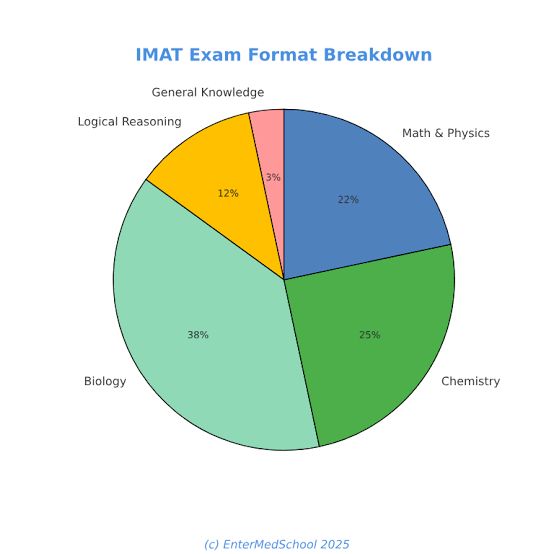
What it is: A 100-minute, 60-question multiple-choice exam testing:
Logical Reasoning & General Knowledge (12 Qs)
Biology (18 Qs)
Chemistry (12 Qs)
Physics & Maths (8 Qs)
Scoring: +1.5 for correct, -0.4 for incorrect, 0 for blank. Max score 90.
Language: English.
When: Once a year, typically mid-September. (2024 date: Sept 12th).
Where: Test centers worldwide (managed by Cambridge Assessment Admissions Testing).
Why it’s Critical for Non-EU: Your IMAT score determines your rank within the dedicated Non-EU quota at your chosen universities. Higher rank = better chance of admission. Public universities rely solely on this rank. Private universities heavily weigh it.
IMAT Guide for Non-EU Students:
Register Early (Crucial!):
Registration opens ~May/June via the Universitaly portal. Do NOT delay.
You’ll select up to two Italian medical universities (in order of preference) where you want your score considered.
Intensive Preparation is Non-Negotiable:
Start Early (6-12 months prior): Biology and Chemistry depth is key. Logical reasoning needs practice.
Use Official Resources: Past papers (available on Cambridge website) are GOLD. Understand the format and question styles.
Consider Prep Courses/Books: Dedicated IMAT prep resources (online/books) are highly recommended due to the specific nature of the exam. DoctorTravelLog can recommend trusted prep providers (Affiliate Link).
Focus on Weaknesses: Don’t neglect Physics/Maths or Logical Reasoning.
Timed Practice: Master the intense time pressure.
Understand the Non-EU Competition: You are only competing against other Non-EU applicants for the designated seats. Aim for a score significantly above the historical cutoff for your chosen universities (cutoffs vary yearly and per uni).
Results & Ranking: Results are released a few weeks after the exam. You will be ranked within the Non-EU quota for each university you applied to via Universitaly.
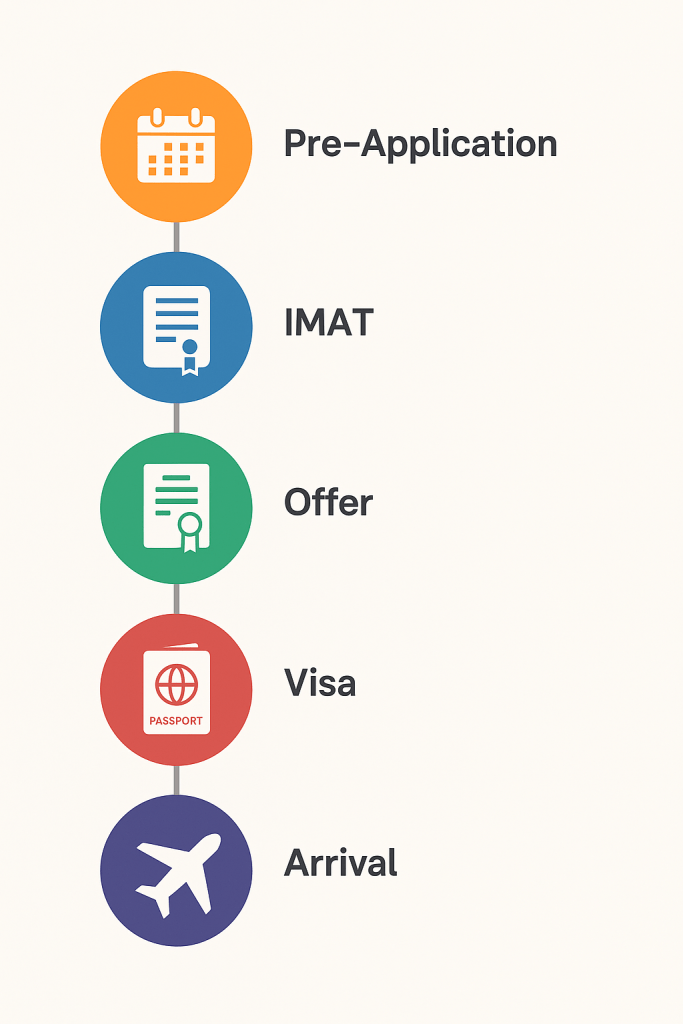
The Application Procedure for Non-EU Students: A Step-by-Step Timeline
Pre-Application (Early – Spring/Summer BEFORE IMAT):
Research Universities: Identify 1-2 target public/private universities. Check their specific requirements, fees (public: ISEE process), and historical Non-EU IMAT cutoffs.
Gather Documents: Start preparing your High School Diploma (or equivalent), Transcripts, Passport, Proof of English (if required, often waived if English is MOI).
Begin IMAT Prep: Enroll in courses, get books, start practicing past papers.
Financial Planning: Calculate costs (tuition + living ~€10,000-12,000/year). For public unis, understand the ISEE process for income-based fees (requires financial docs translated/legalized).
Application Phase (Spring/Summer – Sept):
Pre-enrollment on Universitaly (Critical Step!): Opens ~Spring (e.g., March/April). You MUST pre-enroll for your chosen universities and declare your intent to sit the IMAT. This is mandatory for visa purposes and exam registration. Upload required docs.
Register for IMAT (May/June): Via Universitaly portal during the registration window. Pay the exam fee.
Apply for “Dichiarazione di Valore” (DoV): Contact the Italian Embassy/Consulate in your home country early. The DoV certifies the validity of your high school diploma for Italian universities. This process takes MONTHS. Start ASAP after pre-enrollment. Requirements vary (translation, legalization, Apostille).
Take the IMAT (Mid-Sept): Give it your all!
Post-IMAT & Admission (Oct – Dec):
IMAT Results: Released ~October.
University Ranking Lists: Universities publish Non-EU ranking lists based on IMAT scores. Check the lists for your chosen unis meticulously.
Receive Offer (if ranked high enough): If your rank is within the available seats for a university, you’ll be contacted (usually via PEC email or portal) with an offer. You MUST formally accept within a strict deadline (often just days!).
Finalize Enrollment: Accept the offer, pay the first tuition installment (public: often after fee calculation based on DoV/ISEE docs; private: fixed fee). Submit final documents (DoV, Passport, Acceptance, Payment proof) to the university via Universitaly.
Apply for Student Visa (Type D): Take your university acceptance letter, proof of finances (~€6,000/year minimum), accommodation proof, health insurance, flight itinerary, and DoV to your Italian Embassy/Consulate. Apply immediately after enrollment confirmation.
Pre-Departure & Arrival (Dec/Jan):
Secure Accommodation: University halls or private rentals. Start early!
Health Insurance: Mandatory. Enroll in the Italian National Health Service (SSN) upon arrival (~€150/year) or have equivalent private coverage.
Arrive in Italy: Complete university registration, get residency permit (Permesso di Soggiorno), open bank account, enroll in SSN.
Life as a Med Student in Italy:
Language: While studies are in English, learning Italian is ESSENTIAL for effective clinical rotations (starting ~3rd year) and daily life. Universities often offer courses.
Cost of Living: Varies (North > South). Budget carefully. Part-time work is allowed on a student visa (max 20 hrs/week).
Culture: Embrace the Italian pace, food, and social life. Be prepared for bureaucratic processes.
Is Italy Right for You?
Pros: Affordable quality (public), EU degree, unique experience, IMAT centralizes entry. Cons: High Non-EU competition, intense IMAT prep, complex pre-enrollment/DoV, Italian language necessity for clinics, bureaucratic challenges.
Studying medicine in Italy is an adventure demanding preparation and perseverance, especially for Non-EU students. Master the IMAT, navigate the procedures diligently, embrace the language, and you could find yourself launching a brilliant medical career under the Italian sun. Buona fortuna!
🩺 Dr.Mohammad Rizwan Feroz
👍 Found this helpful? Show some love & follow us on Instagram @doctortravellog for expert tips & fresh updates!
💬 Got thoughts or questions? React below or drop a quick comment — no login needed!
Dreaming of walking the historic halls of a UK medical school, training in the NHS, and earning a globally revered MBBS or MBChB? You’re not alone. The UK’s medical education is a beacon for international students, renowned for its rigor, clinical excellence, and the prestige of institutions like Oxford, Cambridge, Imperial, and UCL. But as a non-EU applicant, the path involves distinct challenges, costs, and processes post-Brexit.
This isn’t about selling a fantasy; it’s your practical roadmap to understanding what it *truly* takes to study medicine in the UK from outside the EU/EEA.
Why the UK? The Enduring Allure
Global Recognition & Standards: A UK medical degree is a passport respected by medical councils worldwide (though licensure in your home country will still require specific exams). The General Medical Council (GMC) sets exceptionally high standards.
Integrated Clinical Exposure: From early years, you’re immersed in the National Health Service (NHS), gaining hands-on experience in diverse clinical settings under expert supervision.
Research Powerhouse: Access to cutting-edge medical research and innovation is embedded in the curriculum at leading universities.
Quality of Teaching: Problem-based learning (PBL) and a strong emphasis on communication and ethics shape well-rounded future doctors.
Cultural & Linguistic Advantage: Studying in an English-speaking country eliminates a major language barrier for many, and the UK offers a vibrant, multicultural student experience.
The Reality Check: Key Challenges for Non-EU Applicants
1. Stiff Competition:
Limited Spaces: Medicine is the most competitive undergraduate degree in the UK. International student quotas are small.
Academic Excellence Required: You’ll need near-perfect grades in science subjects (Biology, Chemistry, often Physics/Maths) equivalent to top A-levels (e.g., A*AA or higher). Your high school qualifications must be rigorously assessed for equivalence (UCAS tariff points).
Entrance Exams: Almost all universities require either the UCAT (University Clinical Aptitude Test) or the BMAT (BioMedical Admissions Test). High scores are non-negotiable. Preparation is intense and costly.
Interviews: Multiple Mini Interviews (MMIs) are standard. They assess communication, empathy, ethics, resilience, and motivation – demanding thorough preparation, often remotely.
2. Significant Financial Investment:
Tuition Fees: This is the biggest hurdle. Non-EU international fees for medicine are substantially higher than for home/EU students. Expect £25,000 to £50,000+ PER YEAR for tuition alone (varies by university, with London/Oxbridge at the top end).
Living Costs: Especially in cities like London, Oxford, or Cambridge, budget at least £12,000 to £18,000+ per year for accommodation, food, transport, books, and personal expenses.
Immigration Health Surcharge (IHS): Mandatory for your Student Visa, granting access to the NHS. Currently £1,035 PER YEAR. Payable upfront for your entire visa duration.
Visa Fees: Application costs add several hundred pounds.
Total Cost: A 5-6 year degree can easily exceed £250,000+. Scholarships are scarce and fiercely competitive for medicine.
3. The Visa Journey:
Student Visa (Tier 4): You’ll need an unconditional offer and proof of sufficient funds covering the first year’s tuition + living costs (held for 28 days minimum) before applying.
English Language Proof: Usually IELTS Academic (typically 7.0+ overall, with minimums in each component) or equivalent.
TB Test: Required if coming from a listed country.
Biometrics & Processing: Allow ample time.
4. Post-Study Work & Foundation Training:
The Graduate Route: Allows you to stay and work (in any field) for 2 years (undergrad) or 3 years (PhD) after graduation. This is your bridge.
Foundation Programme (FY1/FY2): To practice as a doctor in the UK, you must complete this 2-year paid training programme within the NHS.
You compete in a separate, smaller allocation within the national application process.
You need full GMC registration before starting FY1, which requires passing the PLAB (Professional and Linguistic Assessments Board) exams (Part 1 often taken during studies, Part 2 after graduation). This is a major additional hurdle.
Visa sponsorship for the Foundation Programme is complex and not guaranteed.
The Non-EU Applicant Pathway: Step-by-Step
1. Research & Self-Assessment (Early – Years 11/12 or equivalent):
University Shortlisting: Focus on universities welcoming internationals, check their specific entry requirements, fees, UCAT/BMAT policy, and course structure. Use UCAS search tools.
Financial Planning: Be brutally honest about affordability. Explore all potential funding sources early (family savings, home country loans, rare scholarships).
Academic Focus: Excel in core science subjects.
2. Prepare for & Take Entrance Exams (Year 12/AS Level equivalent):
Community: Connect with international student societies and medical student associations. Build a support network.
Work: Student visa allows limited part-time work (usually 20 hrs/week during term, full-time in holidays). Balance is key – medicine is demanding.
Culture: Embrace the experience! Explore the UK, engage with different cultures on campus and in the NHS.
Plan Ahead: Start thinking about PLAB and Foundation Programme applications during your studies. The Graduate Route gives you time, but preparation is lengthy.
Is It Worth It? A Candid Perspective
Studying medicine in the UK as a non-EU student is an incredible opportunity, but it’s a massive investment of intellect, effort, and finances. It’s worth it if:
You are academically exceptional and resilient.
Your family can comfortably afford the entire cost without crippling debt.
You are genuinely passionate about the UK system and potentially working there long-term (understanding the hurdles to Foundation training).
You see the value beyond just the degree – the clinical training, research exposure, and international experience.
It might not be the best path if:
Cost is a primary barrier with no secure funding.
Your primary goal is to practice immediately in your home country (a local or cheaper international degree might be more efficient).
You underestimate the intense competition and workload.
Your Next Steps with DoctorTravelLog:
Resources for Studying Medicine in the UK (for International Students)
Use Our University Finder: Filter UK medical schools by international fees, UCAT/BMAT requirements, and location. Find the perfect fit for your goals and budget.
Download Our Budget Planner: Calculate your realistic total costs (tuition + living expenses) for different universities before applying.
Explore UCAT/BMAT Prep Resources: Access trusted prep courses and practice materials to improve your scores. (Includes affiliate links to recommended providers.)
Book a UK Medicine Consultancy Session: Get personalized advice on your academic profile, application strategy, and university shortlist from experienced consultants.
Join the Forum: Connect with other international applicants and current students. Share your journey, ask questions, and get real insights.
The UK medical dream is demanding, but for the well-prepared, determined, and supported non-EU applicant, it remains a profoundly rewarding journey. Arm yourself with knowledge, plan meticulously, and step forward with your eyes wide open. Your stethoscope awaits – are you ready for the challenge?
Got questions? Share them below or explore DoctorTravelLog’s dedicated UK Medicine section for deeper dives!
— Dr. Mohammad Rizwan Feroz
👍 Found this helpful? Show some love & follow us on Instagram @doctortravellog for expert tips & fresh updates!
💬 Got thoughts or questions? React below or drop a quick comment — no login needed!
Choosing where to pursue your MBBS (Bachelor of Medicine, Bachelor of Surgery) is one of the most significant decisions for an aspiring international doctor. It’s not just about getting a degree; it’s about shaping your future career, lifestyle, and even your worldview. Europe and Asia emerge as two powerhouse destinations, each radiating distinct advantages and challenges. Declaring one universally “better” is impossible – the “best” fit depends entirely on you.
Let’s dissect the pros and cons of pursuing an MBBS in Europe versus Asia to help you navigate this life-altering choice:
The European Pathway: Tradition, Integration & Global Mobility
Pros:
High Standards & Global Recognition: Degrees from accredited EU universities (especially in countries like Germany, Poland, Czech Republic, Hungary, Romania, Bulgaria, Italy, Spain) are widely respected by medical councils globally (USMLE, PLAB, AMC pathways generally smoother). Rigorous quality control is a hallmark.
Integrated EU Practice Potential: Graduating from an EU country often simplifies the process of practicing medicine within other EU/EEA nations due to mutual recognition directives (though language proficiency is still key). This offers incredible career mobility.
Advanced Infrastructure & Research: Access to cutting-edge medical technology, well-equipped teaching hospitals, and opportunities to engage in high-level research projects is often readily available.
Cultural Immersion & Travel: Studying in Europe offers unparalleled access to diverse cultures, languages, and travel opportunities across the continent during breaks.
Focus on Clinical Skills (Often): Many European programs integrate clinical exposure earlier and more consistently than some traditional Asian curricula.
English-Taught Programs: A wide range of universities offer MBBS programs entirely in English, attracting a diverse international student body.
Cons:
Higher Tuition & Living Costs: While often cheaper than the US/UK, tuition fees and especially living expenses (Western/Northern Europe particularly) are significantly higher than in most Asian destinations. Budget realistically.
Competitive Entry: Admission can be highly competitive, requiring excellent high school grades (especially in science subjects), strong entrance exam scores (e.g., IMAT for Italy, NEET for some), and sometimes specific language prerequisites even for English programs.
Language Barrier for Practice: While the degree might be in English, practicing medicine locally requires near-native fluency in the host country’s language (e.g., German, Polish, Czech). Learning this is non-optional for local licensure.
Colder Climate Adjustment: For students from tropical Asia, adapting to long, cold winters in many European destinations can be challenging.
Cultural Adjustment: European social norms, teaching styles, and daily life can feel more distant initially for students from Asian backgrounds compared to studying within Asia.
The Asian Pathway: Affordability, Scale & Diverse Options
Pros:
Significant Cost Advantage: This is often the biggest draw. Tuition fees and living expenses in countries like China, Philippines, Russia, Ukraine (pre-war context is complex), Kyrgyzstan, Kazakhstan, Bangladesh, Nepal, and some programs in India (for NRI/Management quota) are substantially lower than in Europe or the West.
Large International Communities: Many Asian medical universities have well-established systems for international students, large expat communities, and support structures catering specifically to them.
PMC( Pakistan)/MCI/NMC Recognition (Crucial for India): Many universities in China, Philippines, Russia, Bangladesh, Nepal etc., are recognized by India’s National Medical Commission (NMC), allowing graduates to sit for the FMGE (now NEXT) to practice in India. This is paramount for Indian students intending to return home.
Cultural Proximity (For Many): Students from South Asia, Southeast Asia, or the Middle East may find cultural adaptation easier, with familiar food, social dynamics, and potentially shorter travel distances.
Focus on Theoretical Foundation: Some Asian curricula place a strong emphasis on rote learning and theoretical knowledge, which can be advantageous for certain licensing exams.
High Patient Volume: Hospitals attached to universities often see enormous patient volumes, offering exposure to a wide range of cases early on.
Cons:
Variable Quality & Recognition: Quality can vary dramatically between institutions and countries. Vigilant research is CRITICAL. Ensure the university is recognized by the medical council of the country where you intend to practice. (WHO’s World Directory of Medical Schools is a start, but check specific council lists like PMC,BMC,NMC, ECFMG, GMC).
Language of Instruction & Patient Interaction: While programs are marketed in English, clinical rotations often involve patients and local doctors speaking the native language (Mandarin, Russian, Filipino dialects, etc.).This can hinder learning and patient interaction if you’re not proficient.
Infrastructure Disparities: While top universities are excellent, some institutions, especially in less developed areas, may have outdated equipment or facilities compared to European counterparts.
Licensing Exam Hurdles (For Non-Home Practice): Returning to practice in the US, UK, Australia, or even the EU often requires clearing challenging licensing exams (USMLE, PLAB, AMC) and potentially additional internships/training, which can be a long road regardless of where you study.
Cultural & Lifestyle Adjustments: Bureaucracy, teaching styles, food, hygiene standards, and social freedoms can differ significantly and be challenging for some.
Political Instability (Specific Regions): Some popular destinations have experienced political unrest or conflict, impacting student safety and continuity of studies (research current conditions diligently).
Meet the Students:
Sofia (from Brazil): Chose Hungary. “The EU degree recognition was key for me, dreaming of working in Portugal later. Budapest is beautiful, the program is tough but structured. Learning Hungarian is my biggest challenge now!”
Arjun (from India): Chose the Philippines. “Cost was the biggest factor for my family. The NMC recognition list gave me options. English is widely spoken, but learning basic Tagalog helps in the wards. The patient volume is insane – you see everything!”
Beyond the Continents: Key Questions to Ask YOURSELF
Where Do You Want to Practice Ultimately? This is the MOST crucial factor. Research the specific licensing requirements (exams, internships, language) for your target country *before* choosing a medical school. An NMC-recognized Asian university might be “better” for India, while an EU degree eases EU practice.
What’s Your Realistic Budget? Include tuition, accommodation, food, travel, health insurance, and potential language courses for the entire duration. Don’t underestimate living costs in Europe.
How Important is Cultural Proximity & Support? Can you thrive far from familiar comforts, or do you need a larger community from your home region?
What’s Your Learning Style? Do you prefer highly structured, theory-heavy learning (some Asian styles) or earlier clinical integration and problem-based learning (common in Europe)?
Are You Willing to Learn a New Language (Fluently)? For Europe, this is almost mandatory for practice. In Asia, it’s essential for effective clinical rotations and daily life beyond campus.
The Verdict: It’s About Alignment, Not Ranking
There is no single “better” continent for an MBBS. Europe shines with its high global recognition, EU mobility potential, advanced infrastructure, and cultural richness, demanding a higher budget and language commitment. Asia excels in affordability, offers NMC-recognized options crucial for Indian returnees, and provides cultural familiarity for many, requiring careful vetting for quality and presenting language/recognition hurdles for non-home practice.
Your Next Step: Research Relentlessly!
Verify Recognition: Double and triple-check the university is listed on the official medical council websites of your target practice countries (NMC, GMC, ECFMG, AMC etc.). DoctorTravelLog recommends using the official council directories, not just agent claims.
Talk to Current Students & Alumni: Seek honest opinions on curriculum, faculty, facilities, support, and challenges. Explore DoctorTravelLog’s Student Forum (Link) for real experiences.
Consider Lifestyle Fit: Visit if possible, or research extensively. Can you live there happily for 5-6 years?
Understand the Fine Print: Know the total costs, language requirements, internship structure, and FMGE/NEXT/USMLE pass rates of the university.
Ready to chart your medical journey?
Choosing between Europe and Asia is deeply personal. By honestly assessing your goals, budget, and preferences, and conducting meticulous research, you’ll find the medical school that isn’t just a place to study, but the launchpad for your dream career.
Overwhelmed by choices? DoctorTravelLog offers personalized consultancy services and in-depth Country & University Guides. Explore our resources or Book a Consultation today!
Dr. Mohammad Rizwan Feroz
👍 Found this helpful? Show some love & follow us on Instagram @doctortravellog for expert tips & fresh updates!
💬 Got thoughts or questions? React below or drop a quick comment — no login needed!
Forget sterile waiting rooms and astronomical bills. Imagine recovering from knee surgery overlooking the turquoise Persian Gulf, or exploring ancient souks between dental check-ups. This is the evolving reality of medical tourism in the Middle East – a region rapidly transforming into a global healthcare destination. But is this surge a genuine boon for patients and economies, or does it mask potential burdens? Let’s unpack the scalpel-sharp truth.
The Allure: Why Patients are Flocking East
The Middle East isn’t just about oil riches anymore; it’s investing heavily in “healthcare cities” and world-class facilities. Countries like the UAE, Saudi Arabia, Jordan, Turkey, and Iran are leading the charge, offering compelling advantages:
Cutting-Edge Technology & Expertise: State-of-the-art hospitals (often branches of renowned names like Cleveland Clinic, Johns Hopkins Medicine International in Abu Dhabi) boast the latest robotic surgery systems, advanced imaging, and specialized centers for oncology, cardiology, orthopedics, and fertility. Many doctors are Western-trained, bringing international expertise.
Cost Savings (Significant for Some): Compared to the US, UK, or even parts of Europe, complex procedures like cardiac surgery, joint replacements, or advanced dental work can cost 30-70% less, even factoring in travel and accommodation. This makes life-changing treatments accessible.
Luxury & Hospitality: The Middle East excels at high-end service. Many medical tourism packages include 5-star recovery suites, private nurses, concierge services arranging airport transfers and leisure activities. Recovery feels more like a resort vacation.
Reduced Wait Times: Escaping lengthy waiting lists for elective surgeries in public healthcare systems (common in Canada, UK, parts of Europe) is a major driver. Patients can often schedule procedures within weeks.
Cultural & Religious Familiarity: For patients from the wider Muslim world and diaspora, the Middle East offers an environment sensitive to cultural norms, dietary requirements (halal food), prayer facilities, and often, staff speaking their native language. This provides significant comfort during a vulnerable time.
Meet Aisha: A Jordanian-American woman facing a year-long wait for a crucial hip replacement in the US. Drawn by familiarity, renowned surgeons, and a cost saving of nearly 50% including a luxury recovery stay, she chose a top hospital in Dubai.
“It wasn’t just the surgery,” she shared, “it was being understood, cared for culturally, and recovering somewhere peaceful. It felt like healing on my terms.”
The Thorny Side: Potential Burdens to Consider
Despite the shiny allure, medical tourism isn’t without its complexities and risks. Potential burdens lurk beneath the surface:
Quality & Regulation Variability: While flagship hospitals are exceptional, quality and regulation standards vary significantly across the region and even within countries. Thorough research is non-negotiable. Not every “international” hospital meets the same rigorous standards.
The Follow-Up Care Conundrum: What happens when you fly home? Coordinating post-operative care with your home doctor can be challenging. Complications arising weeks later become your local healthcare system’s responsibility, potentially causing friction or gaps in care continuity.
Hidden Costs & Logistical Hurdles: Travel expenses (flights, visas, extended stays for recovery), unexpected complications requiring longer hospitalization, or the need for a companion’s travel can quickly erode initial cost savings. Navigating foreign bureaucracies and healthcare systems adds stress.
Ethical Concerns & Transparency: Issues like organ transplant tourism (with its dark underbelly of trafficking and exploitation, though heavily cracked down upon), lack of price transparency in some facilities, and potential language barriers in informed consent processes raise ethical red flags that demand vigilance.
Impact on Local Populations: Critics argue a focus on lucrative medical tourism could divert resources and top talent away from public healthcare systems, potentially exacerbating inequalities for local citizens needing care. Is the local infrastructure truly benefiting?
Medical-Legal Recourse: Seeking legal recourse for malpractice in a foreign country is often complex, expensive, and faces significant jurisdictional hurdles. Patients may have far less protection than in their home countries.
Dr. Hassan, a leading orthopedic surgeon in Riyadh, acknowledges the challenges: “We offer world-class care, but patient selection and education are paramount. We insist on comprehensive pre-travel consultations and clear, signed agreements regarding follow-up plans with their home physicians. Transparency is key to avoiding burdens.”
Boon or Burden? The Verdict is Nuanced
Labeling Middle Eastern medical tourism solely a “boon” or “burden” is overly simplistic. It’s both, simultaneously. Its success as a boon hinges entirely on:
Informed Decisions: Patients must meticulously research facilities (look for JCI accreditation – Joint Commission International – as a baseline), surgeons, costs, and understand all risks. DoctorTravelLog recommends verified platforms and direct consultations.
Robust Planning: Seamless coordination between the overseas hospital, the patient, and their home healthcare provider before, during, and after treatment is critical.
Choosing Reputable Providers: Opting for established hospitals with transparent practices and international partnerships significantly mitigates risks.
Realistic Expectations: Understanding that while cost savings are possible, luxury packages add expense, and unforeseen complications can occur.
For the Middle East, it’s a powerful economic boon, driving investment, creating jobs, and diversifying economies beyond oil. For the right patient – well-informed, choosing accredited facilities, with a solid follow-up plan – it can be a life-enhancing, even life-saving, boon offering quality care, cultural comfort, and significant value.
For the unprepared patient or one chasing only the lowest price without due diligence, the risks can quickly transform the journey into a significant burden.
The Future: Towards Sustainable Healing
The trajectory points towards growth. Countries like Saudi Arabia (Vision 2030) and the UAE are pouring billions into healthcare infrastructure and digital health records to facilitate seamless international patient care. The focus must be on sustainable, ethical, and patient-centered development – ensuring quality is universal, regulations are stringent and enforced, benefits extend to local populations, and patients are empowered with knowledge.
Your Healing Journey?
Is the Middle East calling you for healthcare? The potential for a positive, transformative experience is real. But approach it with the same diligence you would any major medical decision. Research relentlessly, ask tough questions, prioritize accredited providers, plan your aftercare meticulously, and understand both the gleaming promise and the potential pitfalls.
Considering medical tourism in the Middle East? Share your thoughts, questions, or experiences in the comments below! Stay tuned to DoctorTravelLog for in-depth country guides, hospital reviews, and expert interviews to navigate your healthcare journey abroad safely and successfully.
Dr. Mohammad Rizwan Feroz
👍 Found this helpful? Show some love & follow us on Instagram @doctortravellog for expert tips & fresh updates!
💬 Got thoughts or questions? React below or drop a quick comment — no login needed!
The stark beauty of the desert calls to adventurers, but its unforgiving environment hides dangers most tourists never consider. Understanding essential desert survival medicine isn’t about dramatic Hollywood tropes; it’s about recognizing subtle, life-threatening tourist health risks that escalate with alarming speed. Ignorance of heat illness prevention, dehydration symptoms, and wilderness first aid fundamentals transforms a dream trip into a lethal crisis. What you don’t know about surviving extreme heat, finding water, and treating common desert injuries truly can kill you. This guide, from a medical perspective, reveals the critical gaps in tourist knowledge and the practical survival medicine steps that save lives.
Beyond the Canteen: The Silent Killers Most Tourists Miss
Heatstroke: Not Just “Feeling Hot” – Cellular Shutdown: Tourists often mistake exhaustion (dizziness, nausea, heavy sweating) for just being overheated. Heatstroke, the true killer, is a medical emergency where the body’s core temperature soars past 104°F (40°C), causing cellular breakdown.
Critical ignorance: Sweating often stops in heatstroke as the body fails. Hot, dry, flushed skin with confusion, seizures, or loss of consciousness means imminent organ failure and death.
Survivor Medicine: Prevention is absolute. Hike in coolest hours, wear loose, light-colored clothing covering skin, soak clothes/hat in water. If heatstroke strikes: Immediate, aggressive cooling is the ONLY priority. Get to shade, strip unnecessary clothing, drench with any available water (cool, not ice-cold), fan vigorously. EVACUATE IMMEDIATELY. Every minute counts. Forget “toughing it out” – delay is fatal.
Hyponatremia: When Drinking Water Becomes Poisonous: Everyone knows “drink water,” but few tourists understand hyponatremia – critically low blood sodium from drinking too much plain water without replacing electrolytes lost in sweat.
Critical ignorance: Symptoms mimic dehydration (headache, nausea, fatigue), leading tourists to drink more water, worsening the crisis. Confusion, seizures, coma, and death follow.
Survivor Medicine: Balance is key. Drink steadily (sip, don’t gulp), especially during exertion. Include electrolyte sources: pre-mixed solutions, salty snacks (nuts, pretzels), or even small amounts of broth if available. If severe symptoms develop, stop drinking plain water, consume salty foods if conscious, and seek help. Recognize the paradox: clear urine and worsening symptoms after heavy water intake signals hyponatremia.
Dehydration: The Slow, Insidious Thief of Judgment: Dehydration creeps in long before intense thirst hits.
Critical ignorance: By the time you feel very thirsty, you’re already significantly dehydrated, impairing critical thinking and physical ability – exactly when you need them most to survive. Dark urine, fatigue, headache, and irritability are early warnings tourists often ignore.
Survivor Medicine:Pre-hydrate before activity. Sip constantly (set a timer if needed), aiming for pale yellow urine. Monitor your group – dehydration makes people irrational and less likely to self-care. Eat water-rich foods (fruits, veggies). Rationing water too aggressively early on is dangerous; drink steadily before a crisis.
Beyond Heat & Thirst: Other Overlooked Threats
Venomous Critters: Know Your Enemy (and First Aid Myths): Tourists fear snakes, but scorpions and spiders (like recluses) are common.
Critical ignorance: Most “field extraction” kits (suction devices, cutting) are ineffective and dangerous. Applying ice or tourniquets worsens tissue damage from many venoms.
Survivor Medicine: Prevention: Shake out boots, bedding; watch where you step/place hands. If bitten/stung: Stay calm (panic increases venom spread). Immobilize the limb at heart level. Remove constrictive items (rings, watches). Wash gently with soap/water.Identify the creature ONLY if safe.EVACUATE – antivenom is often the only effective treatment. Forget cutting, sucking, or ice.
Environmental Injuries: Sand, Sun, and Sharp Things: Blistering feet can immobilize. Deep sand cuts easily become infected. Intense UV radiation causes rapid sunburn and eye damage (snow blindness can happen on sand!).
Critical ignorance: Underestimating the speed and severity of sunburn/infection in the dry, dusty environment. Not protecting eyes.
Survivor Medicine: Meticulous foot care (proper boots, moisture-wicking socks, treat blisters early). Clean all wounds immediately with purified water, apply antibiotic ointment, cover. High-SPF broad-spectrum sunscreen reapplied constantly, wide-brimmed hat, UV-blocking sunglasses always.
Getting Lost: The Mental Game: Panic is the enemy.
Critical ignorance: Not telling someone your route/return time. Rushing blindly when lost, expending energy and water.
Survivor Medicine:STOP (Stop, Think, Observe, Plan). Conserve energy and water. Signal for help (mirror, bright clothing, smoke if safe). Stay put if you told someone your plan. Night travel is cooler but riskier for injury.
The DoctorTravelLog Top 3 Desert Survival Prescriptions:
Respect the Heat Relentlessly: Plan around it, dress for it, hydrate for it. Heatstroke kills fast.
Water is Life, But Balance is Key: Sip steadily, include electrolytes, recognize hyponatremia symptoms. Your urine color is your dashboard gauge.
Prepare for the Worst, Hope for the Best: Carry a desert-specific first aid kit (emphasis on wound care, electrolytes, burn gel), signaling devices (mirror, whistle), extra water, navigation tools, and tell someone your plans.
The desert’s majesty demands profound respect. Understanding these hidden medical dangers and the core principles of desert survivor medicine isn’t about fear; it’s about empowerment. Equip yourself with this knowledge, prioritize prevention, and you transform potential lethal threats into manageable challenges, ensuring your desert adventure is remembered for its awe-inspiring beauty, not its peril.
Disclaimer: This article provides general information for educational purposes only and does not constitute medical advice. Always consult with a healthcare professional or wilderness medicine expert before traveling to remote or extreme environments. Proper training (like wilderness first aid courses) is highly recommended.
Sources for Verification (Ensure Originality):
Wilderness Medical Society Clinical Practice Guidelines (Heat Illness, Hyponatremia)
Centers for Disease Control and Prevention (CDC) – Travelers’ Health: Arid Environments
National Park Service – Desert Safety Information
American Hiking Society – Desert Hiking Tips
Peer-reviewed journals: Wilderness & Environmental Medicine, Travel Medicine and Infectious Disease
Dr. Mohammad Rizwan Feroz
👍 Found this helpful? Show some love & follow us on Instagram @doctortravellog for expert tips & fresh updates!
💬 Got thoughts or questions? React below or drop a quick comment — no login needed!

































 Doctor Travel Log